
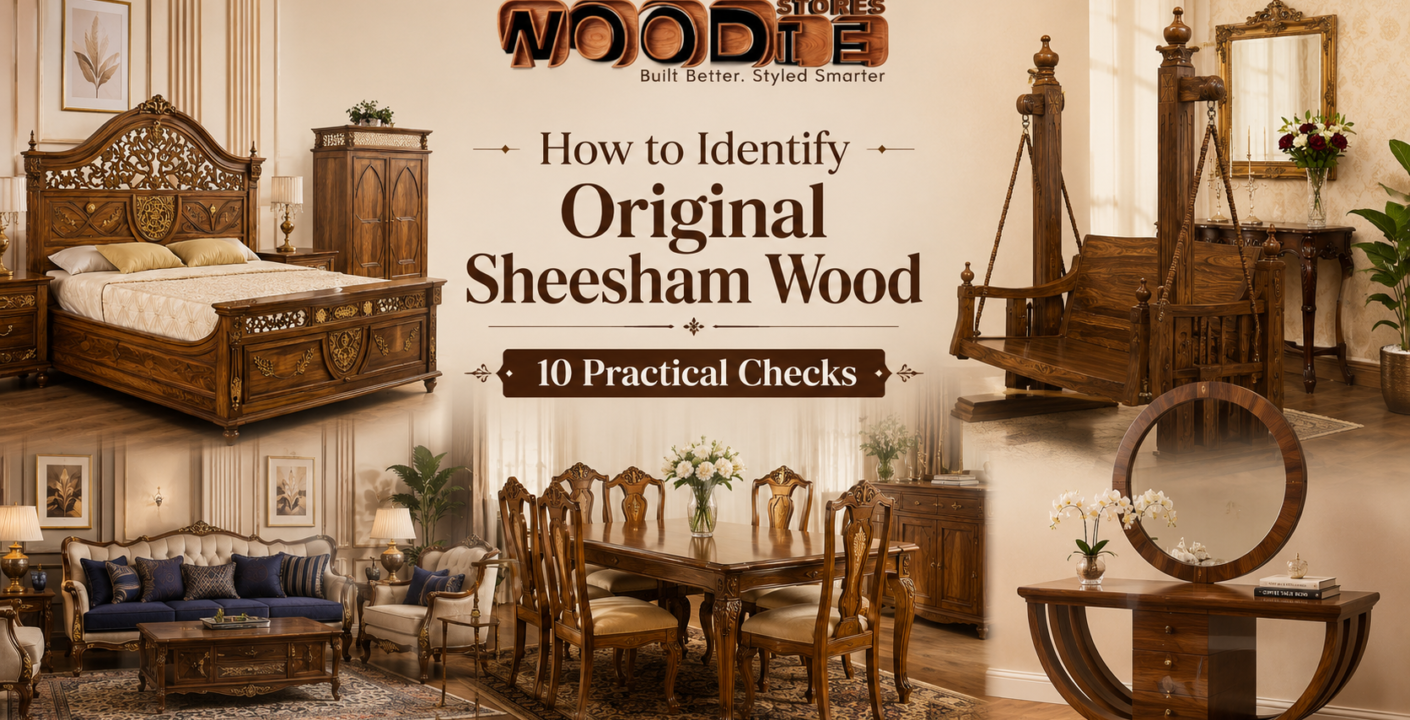

How to identify original Sheesham wood is one of the most important questions for anyone buying wooden furniture in Pakistan. Solid-wood furniture can be a long-term investment, but buyers often struggle to determine whether a bed, sofa, wardrobe or dining table is actually made from genuine Sheesham or simply finished to look similar.
Sheesham, botanically known as Dalbergia sissoo, is widely used for furniture, carving and decorative woodwork across South Asia. The Pakistan Forest Institute describes Sheesham heartwood as ranging from golden brown to dark brown, often with darker streaks, while its sapwood is considerably lighter.
However, no single color, weight or grain pattern can prove that a piece of furniture is genuine Sheesham. Natural wood varies according to age, growing conditions, moisture, cut, seasoning and finish.
The safest approach is to use several checks together.
Table of Contents
- How to Identify Original Sheesham Wood: 10 Practical Checks
- Examine the Natural Wood Color
- Look Closely at the Grain Pattern
- Check Whether the Grain Continues Around Edges
- Inspect Unfinished or Hidden Areas
- Compare the Weight
- Examine the Joints and Construction
- Look for Natural Variation
- Ask Whether the Wood Has Been Properly Seasoned
- Check the Carving
- Ask for Written Material Specifications
- Common Sheesham Identification Questions
- Quick Buyer Checklist
- Frequently Asked Questions
- Final Verdict
How to Identify Original Sheesham Wood: 10 Practical Checks
The following checks can help you inspect a furniture piece more carefully before placing an order. They are practical buying checks rather than laboratory tests, so use them together instead of depending on just one sign.
1. Examine the Natural Wood Color
The first thing many buyers notice is the color.
Sheesham heartwood commonly ranges from golden brown to deeper brown, and darker streaks may appear naturally through the timber. The sapwood is usually much lighter.
Because it is a natural hardwood, genuine Sheesham furniture does not always have one perfectly uniform shade.
Look for:
- Natural changes between lighter and darker brown
- Darker streaks running through some sections
- Slight tonal differences between boards
- Visible natural grain underneath the finish
Be cautious if every visible and hidden surface has exactly the same artificial brown tone.
However, color should never be your only test.
Polish, stain, lacquer and paint can make many different woods look similar.
2. Look Closely at the Grain Pattern
Natural grain is one of the most useful practical clues.
Sheesham commonly shows visible natural grain, and the grain may appear straight in some areas and more varied or interlocked in others.
Real wood usually does not look like the same printed pattern repeated over and over again.
When checking furniture, inspect:
- Headboards
- Bed side rails
- Table tops
- Chair legs
- Drawer fronts
- Wardrobe doors
- Sofa frames
If you are wondering how to identify original Sheesham wood, look carefully at whether the grain changes naturally across different pieces of timber.
A surface pattern that repeats at identical intervals may indicate:
- Decorative laminate
- Printed wood-effect surface
- Veneer
- Engineered board with a decorative layer
Veneer itself is not automatically poor quality. The real issue is whether a veneered product is being sold as solid Sheesham wood.
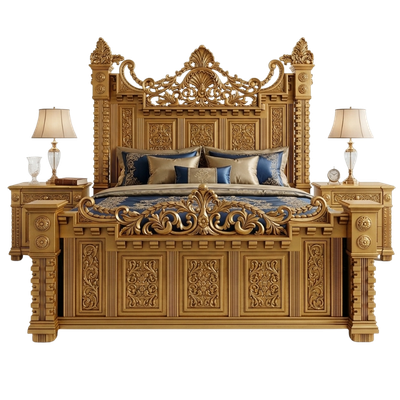
If you are shopping for a solid wooden bed, you can also compare the visible grain across different Sheesham wood bed sets before ordering.
3. Check Whether the Grain Continues Around the Edges
This is one of the easiest checks buyers can perform.
Inspect the edge of:
- A table top
- Shelf
- Drawer front
- Bed panel
- Wardrobe panel
If the component is solid wood, the surface and edge should usually make physical sense together.
For example, the grain should not suddenly stop and reveal an entirely unrelated internal material.
Warning signs can include:
- Fibreboard visible underneath
- Multiple plywood layers
- A very thin decorative surface
- A printed wood pattern ending abruptly at the edge
That does not mean the furniture is necessarily low quality.
Quality furniture may intentionally combine:
- Solid timber
- Plywood
- Veneer
- Engineered panels
The problem is misrepresentation.
If a seller claims the product is “100% solid Sheesham,” ask which exact components are made from solid Sheesham.
4. Inspect Unfinished or Hidden Areas
Polished surfaces can hide the true construction of furniture.
Another practical way to understand how to identify original Sheesham wood is to inspect places where the material is less heavily finished.
Check areas such as:
- Underneath a dining table
- Inside drawers
- Back of the headboard
- Underneath chairs
- Inside a wardrobe
- Around joints
- Under shelves
- Behind removable panels
Compare these hidden areas with the visible front.
Ask yourself:
- Does the material still look like natural timber?
- Can I see natural grain?
- Is the internal material consistent with the seller’s description?
- Can I see MDF, plywood or laminated board?
Hidden areas often reveal much more about furniture construction than the polished exterior.
This is particularly important when purchasing expensive wooden wardrobes or large bedroom furniture.
5. Compare the Weight—but Do Not Depend on Weight Alone
Sheesham is a substantial hardwood, so large solid-wood furniture can feel heavy.
A bed, dining table or chair constructed from significant amounts of solid Sheesham will usually feel substantial when compared with very lightweight furniture.
But there is an important warning:
Heavy does not automatically mean Sheesham.
MDF and other engineered boards can also be surprisingly heavy.
Therefore:
Do not use this logic:
Heavy furniture = genuine Sheesham.
Instead, combine weight with:
- Grain
- Edge inspection
- Hidden surfaces
- Construction
- Written material specifications
Weight is only one supporting clue.
6. Examine the Joints and Construction
Even genuine Sheesham wood does not guarantee high-quality furniture.
Construction matters just as much as material.
Inspect:
- Bed rails
- Sofa frames
- Chair joints
- Table legs
- Drawers
- Wardrobe frames
- Swing supports
Furniture should feel stable and appropriately constructed for its intended use.
A poorly constructed Sheesham bed may still loosen or fail over time.
Look for:
- Stable joints
- Properly aligned components
- Smooth drawer movement
- Properly fitted wardrobe doors
- Strong structural supports
- Consistent workmanship
The USDA’s Wood Handbook explains that wood performance is influenced by factors including grain orientation, moisture and other natural characteristics.
So always evaluate:
Material quality + construction quality
rather than focusing on the wood name alone.
7. Look for Natural Variation Rather Than Perfect Uniformity
Natural wood comes from trees, and trees do not grow with identical printed patterns.
Two boards from the same species—and even from the same tree—can show differences in:
- Grain
- Shade
- Streaking
- Texture
- Figure
That variation is part of natural solid wood.
If a large furniture set has exactly the same repeating grain pattern across every panel, ask the seller whether the surface is:
- Veneered
- Laminated
- Printed
- Engineered
Again, uniform furniture is not necessarily poor furniture.
Engineered materials are specifically manufactured to provide consistency.
The important point is whether the seller is accurately describing the material.
8. Ask Whether the Wood Has Been Properly Seasoned
Do not ask only:
Is this Sheesham wood?
Also ask:
How was the Sheesham wood dried or seasoned before production?
Moisture management matters because natural wood can change dimensions as its moisture content changes.
Poorly prepared timber may be more vulnerable to problems such as:
- Cracking
- Warping
- Joint movement
- Twisting
- Changes in dimensions
A professional furniture seller should be able to explain how the timber is prepared before manufacturing.
For expensive custom furniture, confirm the wood preparation, production process and expected timeline before making the advance payment.
Seasoning is particularly important for large furniture such as beds, dining furniture and wardrobes.
9. Check the Carving on Handcrafted Furniture
Sheesham is widely associated with carved wooden furniture in Pakistan.
If you are inspecting Chinioti or handcrafted furniture, look closely at:
- Floral carving
- Bed crowns
- Chair arms
- Furniture legs
- Wardrobe doors
- Decorative borders
- Sofa frames
- Console tables
The carving should appear to be part of the timber itself rather than simply an artificial decoration attached to the surface.
Look around the carved sections.
In real carved wood, you may see natural grain continuing through the detail.
However, remember:
Carving quality does not prove the species.
Other woods can also be carved.
This is why carving should be considered together with grain, hidden surfaces and material specifications.
If you are comparing different carved designs, browse the Woodie Stores furniture collection and pay attention to how materials and construction are described.
10. Ask for Written Material Specifications
This is one of the most important checks of all.
Do not rely only on verbal statements such as:
Pure wood.
or:
Full Sheesham.
Ask the seller to specify the material used in each major component.
Ask these questions:
Main frame: Is it solid Sheesham?
Headboard: Solid Sheesham or mixed construction?
Side panels: Sheesham, plywood or MDF?
Drawer bottoms: What material is used?
Wardrobe back: Solid wood, plywood or board?
Decorative panels: Solid wood or veneer?
Internal shelving: What material is used?
Furniture can contain more than one material and still be well made.
For example:
Solid Sheesham structural frame with quality plywood backing.
is a clear and transparent description.
That is very different from saying:
100% solid Sheesham
when several components actually use engineered materials.
Get the material specification documented on:
- Quotation
- Invoice
- Order confirmation
- Product specification sheet
This protects both the customer and the furniture seller.
Can You Identify Sheesham Wood by Smell?
Freshly worked timber may have a recognizable natural scent, but smell is not a reliable test for finished furniture.
Why?
Because:
- Polish can mask the smell
- Lacquer can change the smell
- Furniture may be old or stored for months
- Upholstery and other materials can interfere
So smell should only be considered a secondary observation when examining unfinished timber.
Never rely on smell alone.
Should You Scratch Furniture to Check Whether It Is Sheesham?
No.
Do not intentionally scratch finished furniture in a showroom.
A scratch test:
- Damages the finish
- Can reduce the value of the product
- Still does not prove the exact species
Instead, ask the seller to show you:
- An unfinished off-cut
- A production sample
- The underside of the furniture
- An unfinished internal section
For expensive custom furniture, visiting the workshop can be far more useful than damaging a finished piece.
Does Dark Brown Furniture Automatically Mean Sheesham?
No.
Different woods can be stained dark brown.
MDF, plywood and veneer can also be finished to imitate the appearance of natural hardwood.
Genuine Sheesham can range from warmer golden-brown tones to darker brown shades.
Therefore:
Color is evidence—not proof.
Does Heavy Furniture Mean It Is Original Sheesham?
No.
Some engineered boards are also heavy.
If a piece feels substantial, that may support your inspection, but it should never replace checking:
- Grain
- Edges
- Hidden surfaces
- Joints
- Material composition
Can MDF Look Like Sheesham Wood?
Yes.
MDF can be covered with:
- Wood-effect laminate
- Printed finishes
- Veneer
- Decorative sheets
Some modern surfaces can look highly convincing from a distance.
This is why buyers should inspect both the surface and the underlying construction.
If you recently read our guide on Sheesham Wood vs MDF, the same principle applies: appearance alone does not tell you how the furniture is constructed.
Can You Be 100% Certain from Appearance Alone?
Not always.
Professional timber identification can involve microscopic or anatomical examination.
A buyer can use practical checks to detect obvious inconsistencies, but visual inspection alone may not always prove the exact species.
For an unusually expensive purchase or a dispute over wood identity, professional testing or expert wood identification may be more reliable.
Quick Buyer Checklist Before Ordering Sheesham Furniture
Before confirming your furniture order, check:
- Natural color variation
- Grain pattern
- Grain continuation around edges
- Hidden and unfinished areas
- Furniture weight
- Joint quality
- Structural stability
- Natural variation
- Wood seasoning
- Carving quality
- Other materials used
- Exact dimensions
- Finish
- Production timeline
- Delivery terms
- Written material specifications
Do not confirm a high-value custom order until you understand exactly what you are buying.
Why Material Transparency Matters
Not every piece of furniture needs to be made entirely from one material.
MDF, plywood, veneer and solid timber can all have appropriate uses.
The important issue is transparency.
Customers should know:
- What the structural frame is made from
- Which components are solid wood
- Which components use plywood or board
- Which surfaces use veneer
- What is included in the quoted price
Clear specifications create trust and reduce disputes after delivery.
At Woodie Stores, this information should be clearly available for major furniture products before production begins.
Frequently Asked Questions
What does original Sheesham wood look like?
Sheesham commonly has natural brown tones ranging from golden brown to deeper brown, often with darker streaks and visible natural grain. The exact appearance varies because every timber piece is naturally different.
How to identify original Sheesham wood at home?
Start by examining the grain, edges, hidden areas and construction. Compare the visible surface with unfinished parts and ask the seller for written material specifications. No single visual test should be used alone.
Is Sheesham good for furniture?
Sheesham is widely used for beds, tables, chairs, wardrobes and carved furniture because of its natural appearance and suitability for furniture construction and decorative woodworking.
Is Sheesham suitable for carved furniture?
Yes. Sheesham is commonly used for carved furniture, including traditional and Chinioti-style designs. However, carving itself does not prove the wood species.
Can MDF look like Sheesham?
Yes. MDF can use veneer, laminate or printed surfaces that resemble natural wood. Always inspect edges and internal construction.
Should I ask for a wood guarantee?
For expensive custom furniture, requesting written material specifications is a sensible step. The seller should clearly identify which components are Sheesham and whether plywood, MDF, veneer or another material is used elsewhere.
Which Woodie Stores furniture categories can I compare?
You can compare bed sets, sofa sets, dining furniture, wardrobes and other handcrafted wooden furniture through the Woodie Stores catalogue.
Final Verdict
Learning how to identify original Sheesham wood does not mean looking for one magical sign.
The smartest approach is to combine multiple practical checks:
- Color
- Grain
- Edge construction
- Hidden surfaces
- Weight
- Joints
- Natural variation
- Seasoning
- Carving
- Written material specifications
In short, understanding how to identify original Sheesham wood can help buyers avoid fake or misleading furniture claims and make a better long-term purchasing decision.
Natural wood varies, while modern finishes and engineered surfaces can imitate many visual characteristics. That is why transparency from the seller is just as important as visual inspection.
Before buying high-value wooden furniture, confirm the material composition, dimensions, finish, customization options, production timeline, delivery terms and warranty in writing.
That gives you a much stronger basis for choosing genuine, well-constructed furniture with confidence.